
TELEMECANIQUE XCSB701 — Safety Door Switches
Telemecanique XCSB701: metal safety interlock switch, 2 NC + 1 NO, actuator locking, push-button unlocking, up to PL e, IP67, Zamak body.
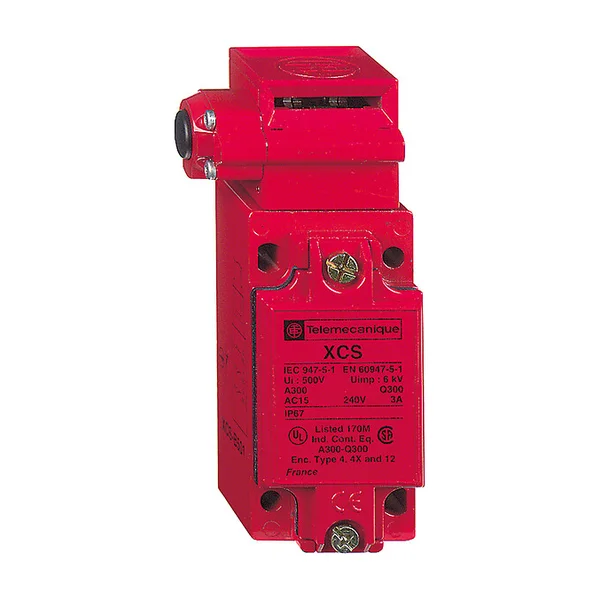
Status: In production
Brand: Telemecanique
Product: Metal safety interlock switch with separate actuator (key-operated)
Contacts: 2 NC + 1 NO
Performance level (PL): Up to PL e, SIL 3, category 4 (with appropriate monitoring)
Locking: Actuator locking, push-button unlocking
Mechanical durability: 600,000 cycles
Degree of protection: IP67
The Telemecanique XCSB701 is an industrial-design metal safety interlock switch from the XCS range. Its key-operated turret head, worked by a separate actuator (key), locks the actuator mechanically; unlocking is by push-button. Contacts are 2 NC + 1 NO, slow-break, break before make, with positive opening of the NC contacts. Resistance to forcible actuator withdrawal is 1500 N. Body and head are Zamak, with one Pg 13.5 tapped cable entry. With the appropriate monitoring system and correct wiring it can reach category 4, PL e and SIL 3.
Rated operational current is 6 A at 120 V and 3 A at 240 V in AC-15, and 0.55 A at 125 V and 0.27 A at 250 V in DC-13; thermal current is 10 A. Mechanical durability is 600,000 cycles and B10d is 5,000,000 for a life time of 20 years. A minimum force of 20 N is needed to extract the actuator; actuation speed is 0.01 to 0.5 m/s. Dimensions are 52 × 114 × 44 mm and weight is 0.475 kg. Operating temperature is -25 to +70 °C, degree of protection IP67; UL and CSA certified.
Telemecanique XCSB701 technical specifications
| General | |
|---|---|
| Product type | Safety switch (actuator-operated) |
| Product range | XCS (XCSB) |
| Design | Industrial, metal |
| Head type | Key-operated turret head |
| Locking | Actuator locking, push-button unlocking |
| Safety ratings | |
| Safety category | Up to category 4 with the appropriate monitoring system and correct wiring (ISO 13849-1) |
| Performance level (PL) | Up to PL e with the appropriate monitoring system and correct wiring (ISO 13849-1) |
| Safety integrity level (SIL) | Up to SIL 3 with the appropriate monitoring system and correct wiring (IEC 61508) |
| B10d | 5,000,000 (for a life time of 20 years) |
| Positive opening | Yes (NC contacts) |
| Electrical characteristics | |
| Contacts | 2 NC + 1 NO |
| Contact operation | Slow-break, break before make |
| Rated operational current | AC-15 A300: 6 A at 120 V, 3 A at 240 V; DC-13 Q300: 0.55 A at 125 V, 0.27 A at 250 V |
| Conventional enclosed thermal current (Ithe) | 10 A |
| Rated insulation voltage (Ui) | 500 V (IEC 60947-1); 300 V (UL 508, CSA C22.2 No 14) |
| Short-circuit protection | 10 A cartridge fuse, type gG (gl) |
| Mechanical and connection | |
| Cable entry | 1 entry tapped for Pg 13.5 |
| Cable outer diameter | 9–12 mm |
| Housing material | Zamak (body and head) |
| Dimensions (W × H × D) | 52 × 114 × 44 mm |
| Minimum actuator force for extraction | 20 N |
| Resistance to forcible actuator withdrawal | 1500 N |
| Net weight | 0.475 kg |
| Mechanical durability | 600,000 cycles |
| Actuation speed | 0.01 to 0.5 m/s |
| Environmental | |
| Operating temperature | -25 to +70 °C |
| Storage temperature | -40 to +70 °C |
| Electrical shock protection class | Class I (IEC 61140) |
| Degree of protection | IP67 (EN/IEC 60529, EN/IEC 60947-5-1) |
| Certifications | UL, CSA |
Key features
- Metal (Zamak) body and head, industrial design
- Actuator locking with push-button unlocking
- Resistance to forcible actuator withdrawal 1500 N
- 2 NC + 1 NO slow-break contacts; positive opening of NC contacts
- Up to category 4, PL e and SIL 3 with appropriate monitoring
- IP67, operating temperature -25 to +70 °C
XCSB701 ordering codes
| Part number | Description |
|---|---|
| XCSB701 | Metal safety switch XCSB, 2 NC + 1 NO, slow-break, actuator locking (push-button unlocking), 1 entry Pg 13.5 |
XCSB701 accessories
Accessories listed by the manufacturer for this product (ordered separately):
| Part number | Description |
|---|---|
| XCSZ25 | Keys for interlock forced opening device (for metal switch) |
| XCSZ27 | Blanking plugs for operating head slot (for metal switch) |
| XCSZ90 | Padlocking device for up to 3 padlocks (compatible with XCSA) |
Other Telemecanique Safety Door Switches
- TELEMECANIQUE XCSA — Metal safety interlock switch with separate actuator (key-operated)
- TELEMECANIQUE XCSC701 — Metal safety interlock switch with separate actuator (key-operated)
- TELEMECANIQUE XCSPA — Plastic safety interlock switch with separate actuator (key-operated)
- TELEMECANIQUE XCSTA591 — Plastic safety interlock switch with separate actuator (key-operated)
- TELEMECANIQUE XCSLF3535312 — Solenoid-locking metal safety interlock switch, 2 NC + 4 NO
- TELEMECANIQUE XCSE7311 — Solenoid-locking metal safety interlock switch, 2 NC + 1 NO
- TELEMECANIQUE XCSLE3535312 — Solenoid-locking plastic safety interlock switch, 2 NC + 4 NO
- TELEMECANIQUE XCSTE5312 — Solenoid-locking plastic safety interlock switch, 1 NC + 1 NO
- TELEMECANIQUE XCSPL562 — Hinge-type safety switch with straight lever, 1 NC + 1 NO
- TELEMECANIQUE XCSPR562 — Hinge-type safety switch with 80 mm spindle, 1 NC + 1 NO
- TELEMECANIQUE XCSTR562 — Hinge-type safety switch with 80 mm spindle, 1 NC + 2 NO
- TELEMECANIQUE XCSM3902L1 — Miniature metal safety limit switch, roller plunger, 2 NC + 1 NO
- TELEMECANIQUE XCSD3902P20 — Compact metal safety limit switch, roller plunger, 2 NC + 1 NO
- TELEMECANIQUE XCSP3902P20 — Compact plastic safety limit switch, roller plunger, 2 NC + 1 NO
Models from other brands: Safety Door Switches
Is this safety switch right for your application?
Share the guard type (sliding, hinged, cover), the need for guard locking, the contact configuration, the cable entry and the required performance level (PL); let’s select the right switch and actuator together.
All product specifications are subject to change without notice. Validation of the safety function and the risk assessment remain the responsibility of the machine builder. Source: Telemecanique Sensors product data sheets (XCSB701_EN.pdf, sheet date 30 July 2024; downloads.telemecaniquesensors.com/dam/datasheets/en/) and telemecaniquesensors.com/global/en/product/reference/ reference pages (accessed 25 September 2026).